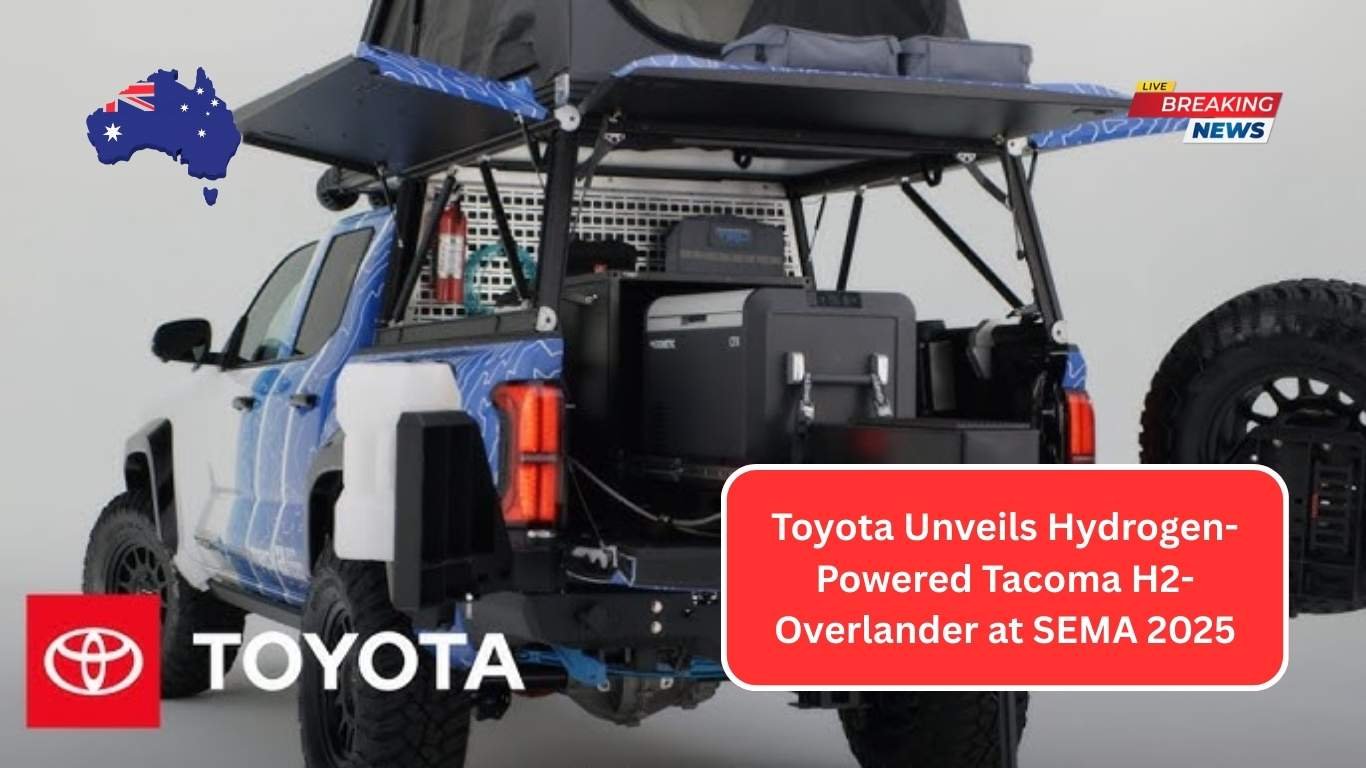
Toyota stunned the automotive world at SEMA 2025 with the debut of the Tacoma H2‑Overlander Concept, a hydrogen‑powered vision for the next generation of sustainable off‑road adventure. Demonstrating how zero‑emission technology can coexist with real‑world utility, the bold concept reimagines the pickup truck as a clean yet capable machine built for rugged exploration.
More than just a showpiece, the H2‑Overlander signals Toyota’s serious intent to expand hydrogen fuel cell applications beyond passenger cars — into the demanding world of overland travel, where reliability and endurance are non‑negotiable.
Hydrogen Power Meets Proven Toughness
Built on the latest Tacoma platform, the H2‑Overlander replaces the traditional internal combustion setup with a hydrogen fuel cell powertrain derived from the Toyota Mirai sedan. By combining the Tacoma’s well‑known durability with zero‑emission propulsion, Toyota has created a powerful testbed for future off‑road innovation.
Instead of burning fuel, the system’s chemical reaction between hydrogen and oxygen produces electricity, emitting only water vapour. The design delivers instant torque and exceptional throttle smoothness — crucial for maintaining control on uneven or slippery terrain. Its near‑silent operation enhances the natural serenity of outdoor exploration while providing precise torque modulation and traction feedback.
Toyota engineers highlight that the H2‑Overlander’s fuel cell setup is perfectly suited to remote environments. It eliminates range anxiety common with battery‑electric vehicles and provides rapid refuelling in minutes rather than hours, a vital advantage for long‑distance off‑road treks where charging networks remain scarce.
Engineered for Real‑World Adventure
In classic Toyota fashion, capability sits at the heart of the Tacoma H2‑Overlander. The concept rides on revised suspension hardware and a lifted chassis to handle the rigours of heavy overlanding use. Wider tracks improve stability on rough ground, while enhanced damper tuning provides balanced comfort across sand, mud, and gravel surfaces.
Large, claw‑pattern all‑terrain tyres wrap around beadlock wheels to protect against punctures, and reinforced body panels resist rock strikes and trail debris. Skid plates, recovery hooks, and an integrated winch system hint at the concept’s extreme readiness for challenging routes.
Despite its futuristic powertrain, the H2‑Overlander retains the toughness that defines every Tacoma. Toyota’s engineers worked to ensure that the fuel cell and hydrogen tanks are shielded by a multi‑layer protection system, safeguarding key components from off‑road hazards.
Design That Blends Utility with Vision
Visually, the H2‑Overlander commands attention. While it shares the Tacoma’s core proportions, the concept introduces a more technical, industrial aesthetic. Its fascia incorporates a blocky grille design housing active vents for cooling, while slim LED lighting elements reinforce its modern character.
A matte‑finish body, widened wheel arches, and a higher beltline emphasize its muscular build. The truck features a roof‑mounted carrier system, external recovery boards, and modular mounts for tents and utility gear — essential tools for serious overlanders.
The rear bed area integrates additional hydrogen storage capacity as part of a symmetrical design that maximizes practicality without compromising aesthetics. Every visual cue underscores the same message: this concept isn’t theoretical. It’s purpose‑built for adventure.
Intelligent Cabin Built for Exploration
Inside, Toyota’s engineers have created a functional yet commanding interior that mirrors the vehicle’s sustainable ethos. Durable, eco‑friendly materials replace traditional plastics, combining long‑term resilience with low environmental impact.
Reinforced seat bolsters, supportive cushioning, and ergonomic spacing make it comfortable for long hours on the road. The digital cockpit features dual high‑definition displays showing hydrogen levels, range estimation, system health, and off‑road diagnostics.
Subtle ambient lighting, adaptive climate control, and modular storage compartments maintain comfort and organization during multi‑day expeditions. The integrated navigation suite links directly to Toyota’s hydrogen fuel infrastructure database, helping drivers locate refueling points along planned routes — a small but crucial detail that turns concept practicality into reality.
Why Hydrogen Makes Sense for Off‑Roading
The Tacoma H2‑Overlander Concept underscores Toyota’s belief in hydrogen as a cornerstone of sustainable transportation, particularly for heavy‑duty and long‑range vehicles. While electric batteries dominate headlines, Toyota argues that hydrogen offers distinct advantages: greater range, minimal downtime, and easy scalability for high‑load applications.
With portable hydrogen storage tanks, recharging in remote areas becomes feasible even without grid access. The lightweight fuel cells also maintain optimal performance regardless of climate — whether traversing deserts, high altitudes, or freezing alpine routes.
According to Toyota’s engineers, hydrogen power gives the H2‑Overlander the endurance necessary for true overlanding adventures, where reliability often trumps outright speed. This technology allows extended operation without carrying excess battery weight, keeping the truck nimble and responsive.
Toyota’s Broader Hydrogen Strategy
The H2‑Overlander isn’t appearing in isolation. It’s part of Toyota’s expanding hydrogen strategy, which spans passenger vehicles, commercial transport, and potentially future trucking platforms. The company has already deployed thousands of hydrogen-powered Mirai sedans globally and continues to support hydrogen infrastructure projects across multiple continents.
At SEMA 2025, Toyota executives emphasized that the Tacoma concept represents a test platform for scaling hydrogen fuel cells into rugged applications. Lessons learned from this prototype will help shape next‑generation trucks capable of zero‑emission towing, trailering, and off‑road use.
A Sustainable Vision for Adventure
The SEMA crowd’s reaction made it clear: the H2‑Overlander stands out not only for its concept but for its credibility. By merging sustainability with dependability, Toyota has illustrated that zero‑emission adventure vehicles are no longer a distant dream.
The approach also reflects a broader shift within the automotive industry — aligning innovation with environmental responsibility without diluting purpose or capability. Toyota’s presentation focused on achieving carbon neutrality through practicality, challenging the perception that green vehicles must compromise performance.
The Road Ahead
While Toyota has no confirmed production timeline for the Tacoma H2‑Overlander, the company hints that future versions of the Tacoma lineup could implement partial hydrogen or hybrid systems inspired by this concept.
Given Australia’s growing interest in hydrogen energy and off‑road leisure vehicles, local markets will be watching closely. The H2‑Overlander proves that next‑generation travel can be cleaner, quieter, and more sustainable — all while remaining rugged enough to take on the unknown.
Final Verdict
In showcasing the Tacoma H2‑Overlander Concept, Toyota has set a new benchmark for off‑road imagination. It brings together the brand’s legendary reliability, bold design philosophy, and commitment to alternate energy innovation in one forward‑thinking package.
Hydrogen propulsion may still be an emerging technology, but this concept shows how it could redefine adventure mobility for decades to come. Efficient, commanding, and environmentally conscious, the H2‑Overlander offers a compelling glimpse into a future where exploration and sustainability travel hand in hand.